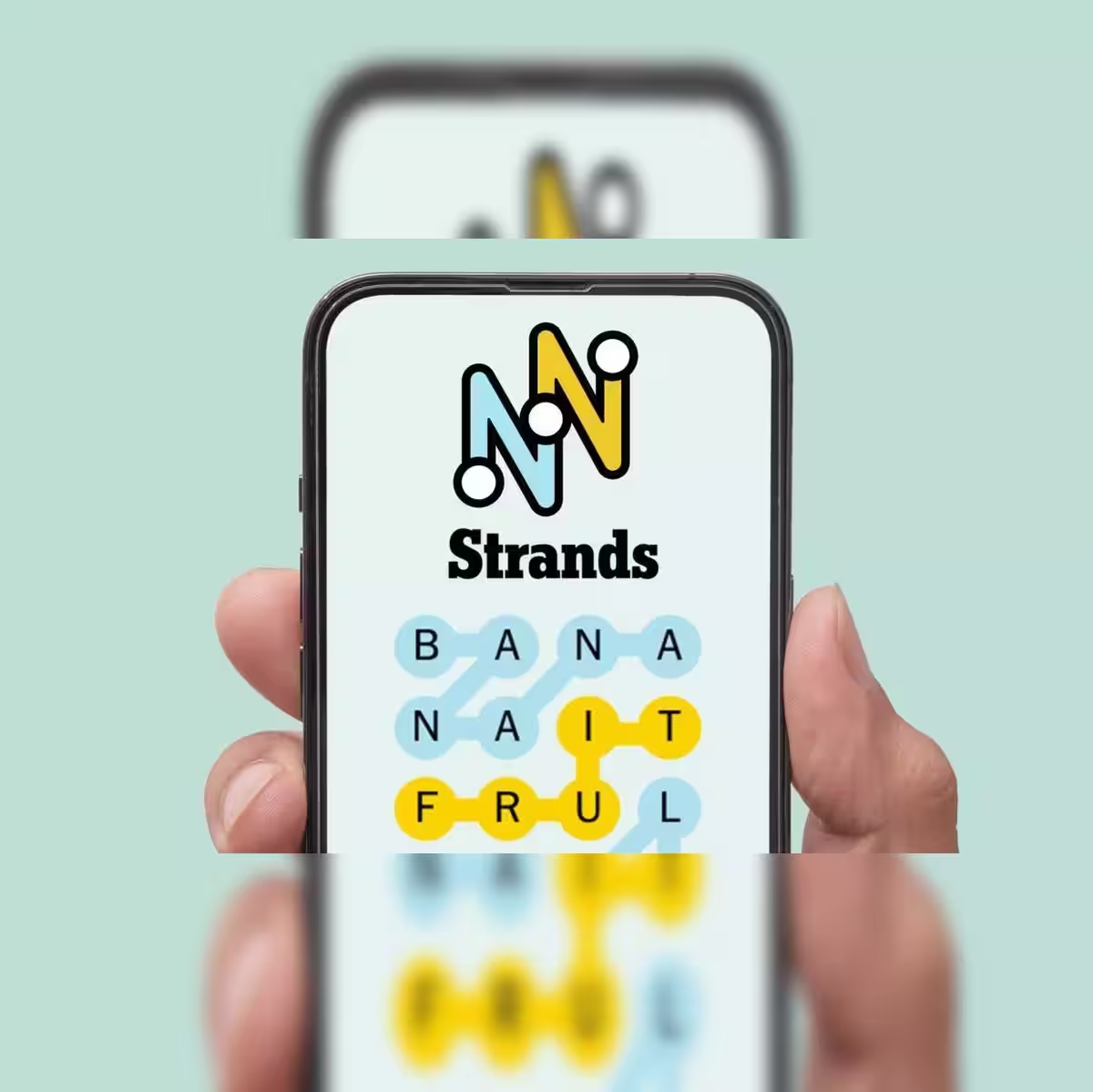
The search for a Strands hint today Forbes has become part of the daily routine for many word-game enthusiasts. The New York Times Strands puzzle combines vocabulary, pattern recognition, and spatial reasoning in a format that can be surprisingly challenging. Unlike a standard crossword, players are not given a list of clues with clearly defined spaces. Instead, they must explore a grid of letters and discover words connected by a hidden theme.
That design is what makes Strands so enjoyable—and occasionally frustrating.
You might discover several words that look promising but have nothing to do with the day’s theme. You may also identify the theme but struggle to find the letters needed to complete the answers. In other cases, the mysterious spangram is the missing piece that finally makes everything make sense.
A carefully designed hint can help without taking away the satisfaction of solving the puzzle. Rather than revealing every answer immediately, today’s Strands assistance can be approached in stages: understand the theme, identify possible word categories, locate useful letter combinations, and only then move toward specific answers.
This guide explains how Strands works, how to approach a difficult puzzle, and how to use hints effectively while continuing to improve your solving skills.
What Is NYT Strands?
Strands is a daily word puzzle published by The New York Times. It presents players with a grid containing letters that can be connected to form words.
The goal is not simply to find random English words. The important words must relate to the puzzle’s daily theme.
This creates two separate challenges.
First, you need to discover the theme. Second, you need to locate words on the board that fit that theme.
How the Letter Grid Works
The Strands board contains letters arranged in a rectangular grid. Adjacent letters can be connected to create words, including diagonal movements.
Words can bend and change direction as they move through neighboring cells. This means an answer may not immediately stand out as it would in a conventional word-search puzzle.
What Is the Spangram?
The spangram is one of the most important elements of Strands.
It is a special word or phrase that describes the overall theme and stretches across the board. Finding it can provide a major breakthrough because it gives you a clearer idea of what all the other answers have in common.
For many players, identifying the spangram is the turning point of the puzzle.
Why Search for “Strands Hint Today Forbes”?
People search for daily hints for different reasons.
Some players want a small clue because they are stuck on the theme. Others have found several answers but cannot identify the remaining words. Some simply want to confirm whether they are moving in the right direction.
The key is that a Strands hint today Forbes search does not necessarily mean someone wants the complete solution.
A useful hint can provide:
- A theme-related clue
- A starting letter
- A word category
- A definition
- A clue toward the spangram
- A strategic suggestion
This gives players an opportunity to continue solving independently.
How to Approach Today’s Strands Puzzle
Before looking for a complete answer, try to work through the puzzle systematically.
Start With the Theme
The theme is your first major source of information.
Read it carefully and consider multiple interpretations. Sometimes a theme sounds broad but is actually pointing toward a very specific category.
For example, if the theme involves “things that fly,” the answers could refer to birds, aircraft, insects, fictional objects, or something completely different depending on the puzzle’s wording.
Do not lock yourself into your first interpretation.
Scan for Familiar Words
Once you understand the general theme, scan the grid for possible answers.
Look for:
- Common prefixes
- Familiar suffixes
- Vowel combinations
- Repeated consonant patterns
- Short words that could expand into longer answers
However, remember that Strands answers do not have to appear in a straight line.
Search Diagonally
One of the biggest mistakes beginners make is focusing exclusively on horizontal and vertical patterns.
Because Strands permits diagonal movement, a word can appear at an unexpected angle.
If you find one or two letters that fit the theme, examine every neighboring position.
Using Strands Hints Without Spoilers
The best hint system is progressive.
Instead of immediately searching for the entire solution, reveal information in stages.
Level One: Theme Direction
The safest hint is a general description of the category.
This gives you enough information to reconsider the board without telling you where the answers are located.
Level Two: Word Meaning
If you are still stuck, a definition can help.
For example, instead of revealing a word, a hint could explain what the word represents.
This approach is particularly helpful when the answer is familiar but difficult to recall.
Level Three: Starting Letter
A starting letter can dramatically narrow the possibilities.
If you know an answer begins with a particular letter and already understand the theme, you can often find the rest of the word yourself.
Level Four: Spangram Assistance
If the entire puzzle feels confusing, focus on the spangram.
Knowing the overarching concept can make every remaining answer easier to identify.
Level Five: Full Answer
Only after trying the previous methods should you look for the complete solution.
That preserves the puzzle’s challenge while still providing a safety net.
Strategies for Finding the Spangram
The spangram can be difficult to spot because you may not know what phrase you’re looking for.
Here are several techniques.
Identify the Broadest Concept
Suppose you discover three words that all belong to a particular category.
Instead of searching for another specific word, ask:
What single phrase could describe all of these words?
That phrase may be the spangram.
Look for Long Paths
The spangram stretches across the board, so it is often longer than many of the other answers.
Look for chains of letters that can create a meaningful phrase related to the theme.
Use Your Existing Answers
Your discovered words are clues to the spangram.
If three answers appear to involve musical instruments, for example, the spangram might identify the broader concept connecting them.
The exact relationship will depend on the day’s puzzle.
Common Strands Mistakes
Even experienced players can lose time by using inefficient methods.
Mistake 1: Guessing Random Words
Random guessing can reveal useful words, but it is not the most efficient strategy.
Use the theme as your filter.
Mistake 2: Ignoring Short Words
A short word can be useful even if it does not appear to be important.
Finding unrelated words may help you earn a hint, so exploring the board is not necessarily wasted effort.
Mistake 3: Assuming Every Word Fits
The board can contain words that are not part of the theme.
Do not force a word into the solution simply because you can find it.
Ask whether it actually matches the puzzle’s concept.
Mistake 4: Forgetting Diagonal Connections
Always examine diagonal paths.
A word that seems impossible horizontally may become obvious when viewed diagonally.
How to Get Better at Strands
Improving at Strands is less about memorizing obscure vocabulary and more about developing a reliable process.
Build Category Awareness
Think in groups.
If a theme suggests animals, mentally consider different animal families. If it suggests foods, consider fruits, vegetables, dishes, ingredients, and cuisines.
This mental categorization helps you search more efficiently.
Expand Your Vocabulary Naturally
Reading widely can improve your Strands performance.
Books, news articles, magazines, documentaries, and educational material all expose you to different words and concepts.
You do not need to memorize every unfamiliar word. Simply becoming comfortable with a wider vocabulary can make future puzzles easier.
Review Completed Puzzles
When you finish a difficult puzzle, take a moment to understand why the answers belonged together.
This helps train your brain to recognize similar relationships later.
Strands Compared With Other NYT Word Games
Strands has a distinct style compared with other popular word games.
Strands vs. Wordle
Wordle focuses on identifying a single five-letter word through letter-position clues.
Strands involves multiple hidden words connected through a theme.
Wordle therefore emphasizes deduction and letter frequency, while Strands puts more emphasis on vocabulary and conceptual relationships.
Strands vs. Connections
Connections asks players to divide 16 words into four groups of four.
Strands instead hides words inside a letter grid.
Both require players to recognize relationships, but Strands adds a spatial component.
Why Daily Hints Are So Popular
Daily puzzle hints have become popular because they offer a balance between assistance and independence.
A player may not want to copy a solution from a website. They simply want enough information to get unstuck.
This is particularly useful for people who play puzzles as part of a morning routine. A short clue can prevent frustration while preserving the feeling of accomplishment that comes from finding the final answer yourself.
Frequently Asked Questions
1. What is the Strands hint today?
The daily Strands hint changes with every puzzle. The most useful first hint usually focuses on the theme rather than immediately revealing an individual answer.
2. What is a spangram in NYT Strands?
A spangram is a special word or phrase that summarizes the puzzle’s theme. It connects the overall concept and can help players identify the remaining hidden answers.
3. Can Strands words move diagonally?
Yes. Players can connect neighboring letters in multiple directions, including diagonally. Words can also change direction as they progress through the grid.
4. How can I solve Strands without looking at the answers?
Start with the theme, search for words that fit the category, examine the grid in every direction, and use unrelated words to work toward available hints. Finding the spangram can also provide a major breakthrough.
5. Is using a Strands hint cheating?
Not necessarily. Many players use hints as a way to overcome a difficult puzzle without immediately seeing the complete solution. The important thing is to use the amount of help that makes the game enjoyable for you.
Final Thoughts
Searching for a Strands hint today Forbes is often less about getting an instant answer and more about finding the right nudge. The puzzle is designed to reward curiosity, vocabulary, and pattern recognition, so even a small clue can be enough to unlock the entire grid.
The strongest strategy is to work systematically. Start with the theme, consider different interpretations, search for words that fit, explore diagonal paths, and use the spangram to understand the broader connection. If you get stuck, use hints gradually rather than jumping straight to the complete solution.
With practice, you will begin to recognize common patterns and solve difficult boards more confidently. And even when a puzzle defeats you, reviewing the answers can teach you something useful for the next day.
Ultimately, Strands is about the satisfaction of making connections. Whether you solve every word on your own or need a carefully chosen hint, the daily puzzle offers a short and engaging mental workout that can become a rewarding part of your routine.