Introduction
Electricity is generated, transmitted, and distributed at different voltage levels. While high voltage is useful for transferring electrical power efficiently over long distances, most household appliances, electronic circuits, and industrial control systems require lower voltages. This is where a step down transformer becomes essential.
A step down transformer is an electrical device designed to reduce alternating current (AC) voltage from a higher level to a lower level. It uses electromagnetic induction to transfer electrical energy between circuits while changing the voltage according to the ratio of its windings.
From neighborhood power distribution systems to chargers, control panels, audio equipment, and industrial machinery, step down transformers are found in countless applications. Understanding how they work, their types, benefits, and limitations can help explain how electrical systems deliver usable power safely and efficiently.
What Is a Step Down Transformer?
A step down transformer is a transformer that reduces the voltage supplied to its primary winding and provides a lower voltage at its secondary winding.
The basic design contains two electrically insulated windings around a magnetic core:
- Primary winding: Receives the higher input voltage.
- Secondary winding: Delivers the lower output voltage.
- Magnetic core: Provides a path for the magnetic flux generated by the alternating current.
The secondary winding contains fewer turns of wire than the primary winding. This difference in winding turns causes the voltage to decrease.
For example, a transformer could be designed to convert 240 volts AC to 24 volts AC. Such a voltage reduction can make the electricity suitable for control circuits and other low-voltage applications.
How Does a Step Down Transformer Work?
The operation of a step down transformer is based on Faraday’s law of electromagnetic induction.
When AC flows through the primary winding, it creates a changing magnetic field in the transformer core. This changing magnetic flux passes through the secondary winding and induces a voltage across it.
The relationship between voltage and the number of turns is approximately:
V₂ / V₁ = N₂ / N₁
Where:
- V₁ = primary voltage
- V₂ = secondary voltage
- N₁ = number of turns in the primary winding
- N₂ = number of turns in the secondary winding
For a step down transformer:
N₂ < N₁
Therefore:
V₂ < V₁
Simple Example
Suppose a transformer has a primary winding with 1,000 turns and a secondary winding with 200 turns. If the primary voltage is 240 V:
V₂ = 240 × (200 / 1,000)
The secondary voltage will be approximately:
48 V
This demonstrates how changing the turns ratio changes the output voltage.
Does a Step Down Transformer Reduce Current?
Although a step down transformer reduces voltage, the secondary current can be higher than the primary current under ideal conditions.
The approximate power relationship is:
V₁I₁ ≈ V₂I₂
This means that if voltage decreases, current can increase while the overall power remains approximately the same, apart from transformer losses.
For example, if a transformer reduces voltage significantly, the secondary winding may be designed to carry a higher current. This is why the wire thickness and transformer rating are important considerations.
Main Parts of a Step Down Transformer
Although transformers vary in size and design, several components are common.
Primary Winding
The primary winding is connected to the incoming AC supply. It receives electrical energy and produces the changing magnetic field required for induction.
Secondary Winding
The secondary winding produces the lower output voltage. Because a step down transformer has fewer turns on the secondary side, its output voltage is lower than the input.
Magnetic Core
The core is usually made from magnetic material and provides a low-reluctance path for magnetic flux. Laminations can be used to reduce certain losses caused by circulating currents within the core.
Insulation
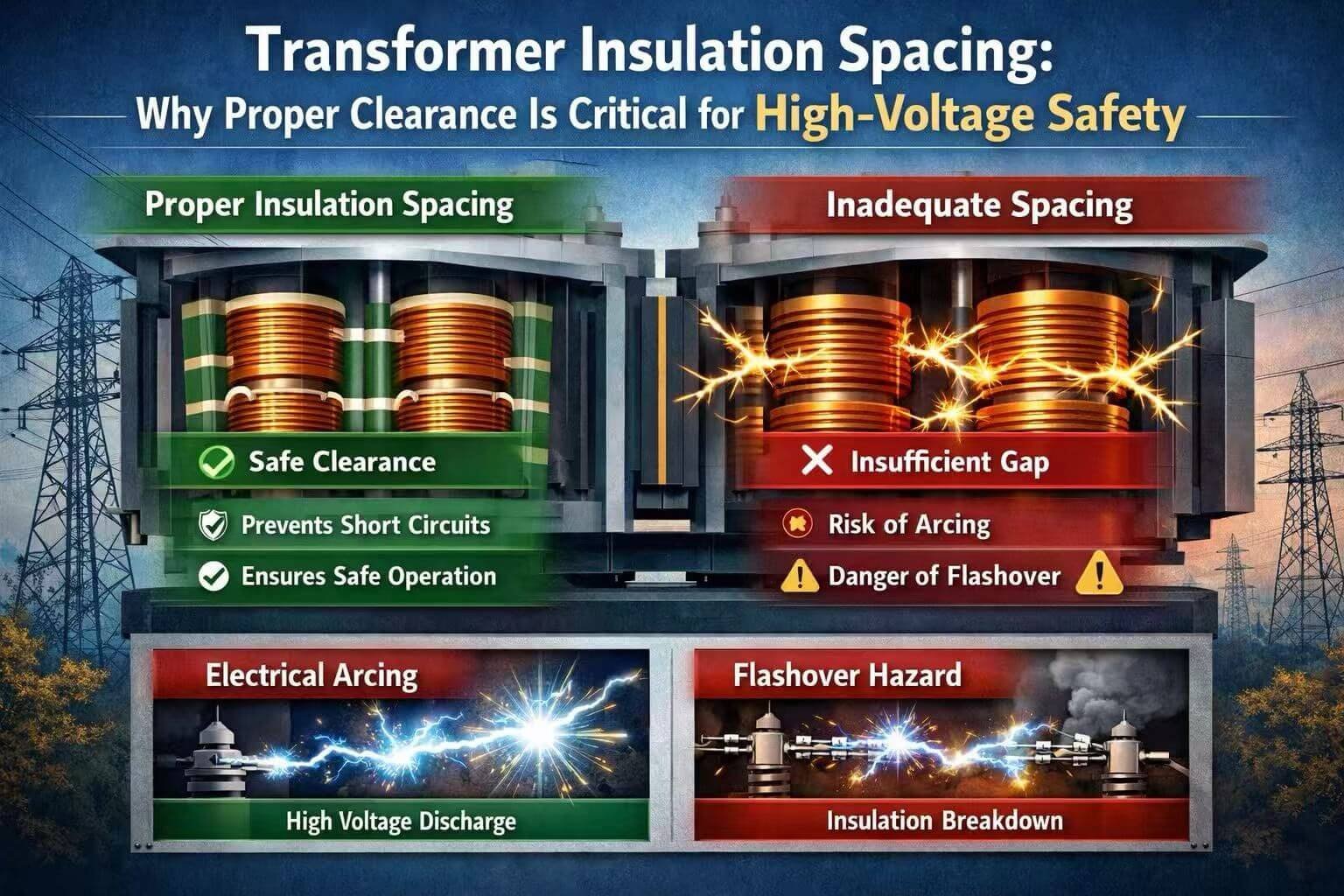
Insulating materials separate the windings from each other and from the core. Proper insulation is particularly important in high-voltage transformers.
Cooling System
Transformers generate some heat during operation. Small transformers may rely on natural air cooling, while larger units can require more advanced cooling arrangements.
Types of Step Down Transformers
Different applications require different transformer designs. Some common types include the following.
Single-Phase Step Down Transformer
Single-phase transformers are commonly used in residential, small commercial, and control applications.
They can convert a higher AC voltage into a lower voltage suitable for equipment and electrical circuits.
Three-Phase Step Down Transformer
Three-phase transformers are widely used in industrial facilities and electrical distribution networks.
They are designed to handle three-phase electrical power and can be more practical than using several individual single-phase transformers for large loads.
Distribution Transformer
Distribution transformers reduce electrical voltage before power reaches consumers.
They are commonly installed on utility poles, in substations, or in ground-mounted enclosures. Their purpose is to provide an appropriate voltage level for local electrical distribution.
Control Transformer
Control transformers are used in industrial control systems. They provide lower voltages for components such as relays, contactors, sensors, and control circuits.
For example, a machine may operate using a higher voltage while its control circuit operates at a lower, more manageable voltage.
Isolation Transformer With a Step-Down Ratio
Some transformers are designed to provide both voltage reduction and electrical isolation. However, isolation characteristics depend on the specific transformer design and winding arrangement.
Common Applications of Step Down Transformers
Step down transformers are used across residential, commercial, industrial, and electronic systems.
Residential Electrical Systems
Power entering a local distribution network may be reduced before being supplied to homes. Distribution transformers play a critical role in providing usable voltage to residential consumers.
Industrial Equipment
Factories often use step down transformers to supply lower voltage to machinery controls, lighting systems, instrumentation, and specialized equipment.
Electronic Devices
Many electronic systems require much lower voltages than the available AC supply. Transformers can provide the appropriate AC voltage before additional rectification and regulation stages are used.
Doorbells and Control Circuits
Low-voltage transformers are commonly associated with doorbells, access-control systems, HVAC controls, and other low-voltage applications.
Audio Equipment
Traditional audio equipment can use transformers for voltage conversion, isolation, impedance matching, or signal transfer.
Renewable Energy Systems
Solar and other renewable energy installations may include transformers as part of their electrical conversion and grid-connection systems.
Step Down Transformer vs. Step Up Transformer
The main difference is the direction of voltage conversion.
| Feature | Step Down Transformer | Step Up Transformer |
|---|---|---|
| Voltage | Decreases | Increases |
| Secondary turns | Fewer | More |
| Secondary current | Generally higher | Generally lower |
| Common application | Distribution and equipment | Power transmission |
| Main purpose | Provide lower voltage | Provide higher voltage |
Both types rely on the same fundamental principle of electromagnetic induction.
Advantages of a Step Down Transformer
Efficient Voltage Reduction
Transformers can reduce AC voltage efficiently, making them suitable for many electrical applications.
Reliable Operation
A properly designed transformer can operate reliably for many years when used within its rated specifications.
Electrical Isolation
Certain two-winding transformer designs can provide electrical separation between the input and output circuits.
Wide Range of Applications
Step down transformers are useful in power distribution, electronics, industrial automation, control systems, and many other fields.
Improved Equipment Compatibility
Many electrical components are designed to operate at specific lower voltages. A transformer can provide a suitable voltage level rather than connecting the equipment directly to a higher supply.
Limitations of Step Down Transformers
Step down transformers are not perfect. They have several limitations that should be considered.
Energy Losses
Real transformers experience losses, including copper losses in the windings and core losses in the magnetic material. As a result, output power is slightly lower than input power.
Heat Generation
Losses produce heat, which can affect transformer performance and lifespan if cooling is inadequate.
Size and Weight
Large transformers can be heavy and require substantial installation space.
AC Operation
Traditional transformers rely on changing magnetic fields and therefore are designed primarily for AC systems. A steady DC supply does not operate a conventional transformer in the same way.
Voltage Regulation
The actual output voltage can vary with load. A transformer may produce a slightly different voltage under no-load and full-load conditions.
How to Choose the Right Step Down Transformer
Selecting a transformer requires careful consideration of the application.
Check the Input Voltage
The transformer’s primary voltage rating must match the intended supply.
Determine the Required Output Voltage
The secondary voltage should be appropriate for the equipment or circuit being powered.
Calculate the Power Requirement
Transformers are commonly rated in VA or kVA. The selected transformer should have an adequate rating for the connected load.
For example, if equipment requires 500 VA, selecting a transformer with an appropriate margin above that requirement can help accommodate operating conditions and avoid excessive loading.
Consider Frequency
The transformer must be compatible with the system frequency, such as 50 Hz or 60 Hz, depending on the application.
Consider the Environment
Temperature, ventilation, humidity, dust, altitude, and installation location can all affect transformer selection.
For high-voltage or industrial applications, selection and installation should be performed by qualified electrical professionals.
Step Down Transformer Efficiency
Transformer efficiency describes how effectively the device transfers electrical power from the primary side to the secondary side.
It can be expressed as:
Efficiency = Output Power / Input Power × 100
A transformer with 95% efficiency transfers most of its input power to the load, while the remaining energy is lost mainly as heat and other losses.
Efficiency depends on factors such as:
- Transformer design
- Core material
- Winding resistance
- Load level
- Operating temperature
- Construction quality
Large power transformers can achieve very high efficiency when operating under suitable conditions.
Safety Considerations
Transformers can operate at dangerous voltages and currents, even when the secondary voltage is relatively low.
Important safety practices include:
- Never work on an energized transformer unless properly qualified and authorized.
- Use appropriate protective equipment.
- Follow the manufacturer’s installation instructions.
- Use correctly rated fuses and circuit protection.
- Ensure proper grounding where required.
- Keep ventilation and cooling paths clear.
- Inspect transformers regularly for overheating, damage, unusual noise, or insulation problems.
A transformer should always be selected and installed according to applicable electrical codes and manufacturer specifications.
Frequently Asked Questions
1. What is a step down transformer used for?
A step down transformer is used to reduce AC voltage from a higher level to a lower level. It is commonly used in power distribution, industrial controls, electronics, and electrical equipment.
2. How does a step down transformer reduce voltage?
It has fewer turns on its secondary winding than on its primary winding. Electromagnetic induction transfers energy between the windings while the turns ratio determines the approximate voltage ratio.
3. Does a step down transformer increase current?
Generally, yes. When voltage is reduced, the available secondary current can increase for a given power level, although real transformers have efficiency losses.
4. Can a step down transformer work with DC?
A conventional transformer is designed for AC rather than steady DC. Applying steady DC can cause excessive current and heating because the required changing magnetic field is absent.
5. What is the difference between a step down transformer and an adapter?
A transformer specifically changes AC voltage through electromagnetic induction. An adapter or power supply may contain a transformer but can also include rectifiers, voltage regulators, switching electronics, and other components.
Conclusion
A step down transformer is a vital component in modern electrical systems because it allows higher AC voltages to be reduced to safer and more useful levels. Its operation is based on electromagnetic induction, with the ratio of primary and secondary winding turns determining the approximate voltage conversion.
From utility distribution networks and industrial machinery to control circuits and electronic equipment, step down transformers serve a wide variety of purposes. They can provide efficient voltage conversion, reliable operation, and, in suitable designs, electrical isolation between circuits.
Choosing the right transformer requires attention to input and output voltage, power rating, frequency, cooling, efficiency, installation environment, and safety requirements. When properly selected and maintained, a step down transformer can provide dependable service for many years.
Understanding how these devices work also makes it easier to understand the larger electrical system around us. Whenever electrical energy needs to move from a higher voltage level to a lower one, the step down transformer remains one of the most practical and important technologies available.