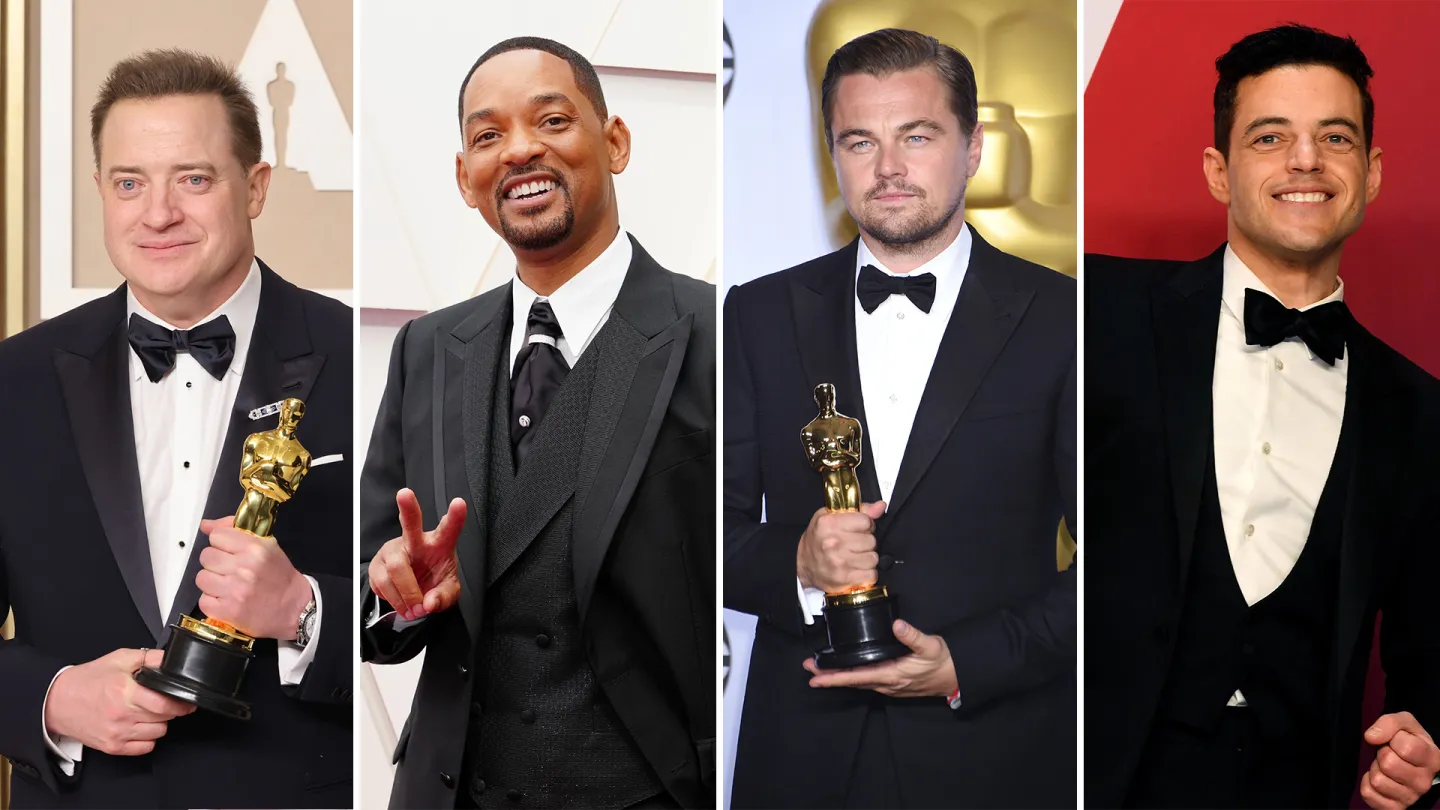
The Academy Award for Best Actor winners & nominees represent some of the most memorable performances in the history of cinema. Every year, the Academy of Motion Picture Arts and Sciences recognizes outstanding acting performances, creating a list of winners and nominees that reflects changing filmmaking styles, cultural conversations, and audience expectations.
Winning the Best Actor Oscar is one of the highest achievements available to a male performer in film. However, receiving a nomination is itself a significant accomplishment. Over the decades, actors from different countries, generations, and acting traditions have competed for the award, producing an extraordinary collection of performances.
From dramatic transformations and historical characters to subtle portrayals of ordinary people, the Best Actor category has covered an enormous range of storytelling. Some winners became synonymous with a particular role, while others used their Oscar victories as milestones in long careers.
This guide explores the history of the Academy Award for Best Actor, notable winners and nominees, important records, memorable performances, and why the category remains one of the most closely watched awards during Oscar season.
What Is the Academy Award for Best Actor?
The Academy Award for Best Actor is presented annually to recognize an outstanding leading performance by a male actor in a film.
The award is part of the acting categories presented at the Academy Awards, commonly known as the Oscars.
The category has existed since the first Academy Awards ceremony in 1929.
The First Best Actor Winner
At the first Academy Awards, Emil Jannings received the award for his performances in The Last Command and The Way of All Flesh.
The early Oscars were different from the modern ceremony. The Academy recognized performances across a period rather than following exactly the same nomination structure used today.
Over time, the Best Actor category developed into the format audiences recognize today, with several nominated performances competing for a single winner.
How Best Actor Nominees Are Selected
The Academy’s acting branch plays a major role in determining acting nominees.
Actors are considered for performances released during the applicable eligibility period. Academy members then participate in the nomination and voting processes according to the organization’s rules.
The number of nominees can vary depending on Academy rules and voting outcomes.
Winner Versus Nominee
There is an important distinction between winning and being nominated.
An actor who wins receives the Oscar, but every nominated performer has been recognized by the Academy as being among the year’s strongest contenders in the category.
Some performances that lost the Oscar have become just as famous—or sometimes more famous—than certain winning performances.
This is why discussions about Academy Award for Best Actor winners & nominees should include both groups.
Notable Academy Award for Best Actor Winners
The Best Actor category includes an extraordinary list of winners.
Actors such as Spencer Tracy, Laurence Olivier, Marlon Brando, Jack Nicholson, Robert De Niro, Daniel Day-Lewis, Anthony Hopkins, Denzel Washington, and Leonardo DiCaprio have all received the award.
Each generation has produced performers whose Oscar-winning roles became important parts of film history.
Spencer Tracy
Spencer Tracy won Best Actor twice, for Captains Courageous and Boys Town.
His performances demonstrated the strength of understated acting and helped establish him as one of Hollywood’s most respected performers.
Marlon Brando
Marlon Brando became one of the most influential actors of the twentieth century.
He won Best Actor for On the Waterfront and later received another nomination for The Godfather.
Brando’s approach to acting influenced generations of performers.
The Godfather Legacy
Although Brando won for On the Waterfront, his portrayal of Vito Corleone in The Godfather became one of the defining performances of American cinema.
The role illustrates why Oscar discussions cannot be limited to winners alone.
Jack Nicholson
Jack Nicholson is another major figure in the Best Actor category.
He won for One Flew Over the Cuckoo’s Nest, As Good as It Gets, and also received the Best Supporting Actor award for Terms of Endearment.
His Best Actor victories span very different periods and styles of filmmaking.
Daniel Day-Lewis
Daniel Day-Lewis is frequently highlighted when discussing Best Actor records.
He won the category three times, for:
- My Left Foot
- There Will Be Blood
- Lincoln
His performances are often associated with extensive character preparation and physical transformation.
Why His Wins Stand Out
Day-Lewis’s three Best Actor victories demonstrate an unusual combination of critical recognition and longevity.
His portrayal of Daniel Plainview in There Will Be Blood and Abraham Lincoln in Lincoln became especially influential examples of modern screen acting.
Recent Generations of Best Actor Winners
The Best Actor award has continued to recognize both established stars and performers receiving their first major Oscar recognition.
Recent winners have included actors such as Brendan Fraser, Cillian Murphy, and Adrien Brody.
Cillian Murphy
Cillian Murphy won Best Actor for Oppenheimer at the 2024 Academy Awards.
His performance as J. Robert Oppenheimer required him to portray a complex historical figure across different stages of his life.
The film, directed by Christopher Nolan, became one of the major cinematic events of its year.
A Career Milestone
Murphy’s Oscar victory represented a major milestone in a career that had included acclaimed performances in film and television.
His win also demonstrated how the Academy can recognize actors after many years of critically respected work.
Brendan Fraser
Brendan Fraser won Best Actor for The Whale at the 2023 Academy Awards.
His performance as Charlie required substantial physical transformation and focused heavily on emotional vulnerability.
The award marked a notable new chapter in Fraser’s career after decades of work in entertainment.
Famous Best Actor Nominees Who Did Not Win
Some of the most celebrated performances in cinema history were nominated for Best Actor but did not win.
This is an important part of the award’s history.
Leonardo DiCaprio Before His Win
Leonardo DiCaprio received several acting nominations before finally winning Best Actor for The Revenant.
His earlier nominations included performances in:
- What’s Eating Gilbert Grape
- The Aviator
- Blood Diamond
- The Wolf of Wall Street
His eventual victory became one of the most widely discussed Oscar moments of his career.
The Revenant
In The Revenant, DiCaprio portrayed frontiersman Hugh Glass.
The physically demanding role required extensive outdoor filming and contributed to the perception of the performance as a major acting challenge.
Peter O’Toole
Peter O’Toole is another famous example of a highly acclaimed actor who accumulated numerous Best Actor nominations without winning competitively during his lifetime.
He received eight Best Actor nominations.
Although he did not win a competitive Best Actor Oscar, he received an Honorary Academy Award in 2003.
His career illustrates the difference between critical recognition and competitive Oscar success.
Best Actor Records and Milestones
The history of Academy Award for Best Actor winners & nominees contains numerous records.
Most Best Actor Wins
Daniel Day-Lewis holds the record for the most Best Actor victories, with three.
Other actors have won the category twice, including Spencer Tracy, Fredric March, Gary Cooper, Marlon Brando, Jack Nicholson, Dustin Hoffman, Tom Hanks, Sean Penn, Anthony Hopkins, and others.
Youngest Best Actor Winner
Adrien Brody became the youngest Best Actor winner when he won for The Pianist at age 29.
His victory was notable because the performance came in a serious historical drama directed by Roman Polanski.
Oldest Best Actor Winner
Anthony Hopkins became the oldest Best Actor winner when he won for The Father.
His victory at age 83 demonstrated that major acting recognition is not limited to younger performers.
Why These Records Matter
Oscar records provide interesting historical context, but they do not necessarily determine the quality of a performance.
Acting is subjective, and every era has different standards, genres, and filmmaking approaches.
Best Actor Winners From Different Genres
One reason the category remains fascinating is its diversity.
Best Actor winners have come from dramas, comedies, historical films, biographical movies, thrillers, musicals, and other genres.
Drama
Drama has historically been one of the most common genres represented among Best Actor nominees.
Performances dealing with grief, conflict, relationships, social injustice, or personal transformation frequently attract awards attention.
Comedy
Although dramatic performances have traditionally dominated major acting categories, comedic performances have also been recognized.
Actors such as Roberto Benigni demonstrated that comedy and dramatic emotion can coexist within an Oscar-winning performance.
Historical and Biographical Roles
Actors playing real historical figures are frequently discussed during awards season.
Portraying a real person creates unique challenges because performers must balance interpretation with recognizable historical characteristics.
Examples include performances portraying Winston Churchill, Abraham Lincoln, Stephen Hawking, Ray Charles, and J. Robert Oppenheimer.
What Makes an Oscar-Worthy Best Actor Performance?
There is no single formula for winning Best Actor.
However, several characteristics often appear in highly successful performances.
Transformation
Physical or behavioral transformation can attract attention.
Actors may change their appearance, voice, movement, or mannerisms to embody a character.
Emotional Complexity
Performances with emotional layers often receive critical attention.
An actor may need to communicate conflicting feelings without explicitly explaining them through dialogue.
Historical Importance
Films addressing significant historical events or social issues can generate additional attention during awards season.
Screen Presence
A strong leading performance must command the audience’s attention.
Sometimes this comes through dramatic intensity; other times it comes through subtlety and restraint.
Why Best Actor Nominees Matter Even Without a Win
A nomination can have a significant impact on an actor’s career.
It can increase visibility, attract new opportunities, and establish a performer as a major talent.
For some actors, an Oscar nomination becomes a career-defining milestone even if another performer ultimately wins.
The Oscar Nomination Effect
An acting nomination can lead to:
- Greater industry recognition
- More prominent roles
- Increased international visibility
- Higher-profile collaborations
- Stronger opportunities for future awards
However, many acclaimed actors have built successful careers without ever winning a competitive Oscar.
Frequently Asked Questions
1. When was the first Academy Award for Best Actor presented?
The first Academy Awards were held in 1929. Emil Jannings received the award for his performances in The Last Command and The Way of All Flesh.
2. Who has won the most Best Actor Oscars?
Daniel Day-Lewis holds the record with three Best Actor victories.
3. Can an actor be nominated for more than one film in the same year?
Under modern Academy rules, an actor cannot normally receive multiple nominations in the same acting category in one year, although there have been historical variations in Oscar rules.
4. Who is the youngest Best Actor winner?
Adrien Brody became the youngest Best Actor winner when he won for The Pianist at age 29.
5. Is an Oscar nomination as important as winning?
Winning is the highest competitive recognition in the category, but an Oscar nomination is itself a major achievement and can significantly enhance an actor’s reputation and career opportunities.
Conclusion
The history of Academy Award for Best Actor winners & nominees is essentially a history of changing ideas about acting and cinema.
From the earliest Academy Awards to today’s global film industry, the category has recognized performances that challenge audiences, embody real people, explore difficult emotions, and redefine what leading-man performances can achieve.
Names such as Spencer Tracy, Marlon Brando, Jack Nicholson, Daniel Day-Lewis, Anthony Hopkins, Leonardo DiCaprio, Brendan Fraser, and Cillian Murphy represent only a small selection of the performers who have shaped the category.
At the same time, the nominees who did not win remain an essential part of Oscar history. Many losing performances have become classics, demonstrating that awards results cannot always determine a film’s lasting artistic importance.
Ultimately, the Academy Award for Best Actor is about more than a golden statuette. It represents recognition from one of the world’s most influential film organizations and provides a snapshot of the performances that captured the industry’s attention during a particular year.
For movie fans, exploring the Academy Award for Best Actor winners & nominees offers an excellent way to discover acclaimed films, legendary performers, overlooked performances, and different eras of cinematic history. Whether an actor wins or simply earns a nomination, becoming part of this remarkable legacy is an achievement that can remain significant for generations.